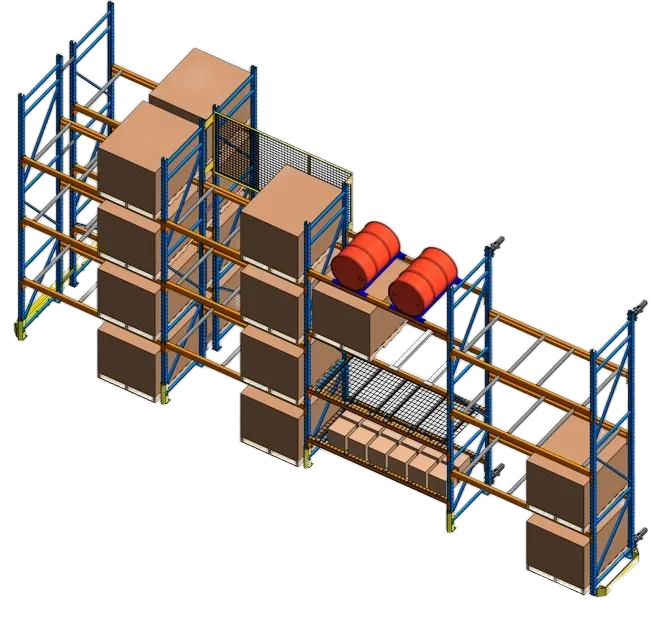
1. Product Overview
Heavy-Duty Warehouse Racking is a high-load storage system specifically designed for industrial warehousing, suitable for storing goods in medium to large warehouses. Known for its exceptional load-bearing capacity, structural stability, and space efficiency, this type of racking has become one of the core equipment in modern logistics and warehousing.
2. Key Features
-
High Load Capacity: Each layer can typically support over 500kg, with some models capable of bearing several tons, making them ideal for heavy goods.
-
Modular Design: Allows for flexible combination and adjustment of shelf height and quantity.
-
Space Efficiency: Maximizes vertical warehouse space for three-dimensional storage.
-
Sturdy Structure: Made from high-quality steel and designed with professional mechanical calculations.
-
Strong Compatibility: Works seamlessly with forklifts, stackers, and other material-handling equipment.
3. Main Types
1. Beam-Type Heavy-Duty Racking
-
The most common type of heavy-duty racking
-
Consists of upright frames, beams, and decking
-
Ideal for palletized goods
2. Narrow-Aisle Racking
-
Features narrower aisles, requiring specialized forklifts
-
Increases space utilization by over 30% compared to standard heavy-duty racking
3. Double-Deep Racking
-
Combines front and back rows of racks
-
High storage density, suitable for large quantities of similar items
4. Push-Back Racking
-
Operates on a Last-In-First-Out (LIFO) or First-In-First-Out (FIFO) basis
-
Ideal for goods requiring specific retrieval sequences
4. Technical Specifications
| Parameter | Range |
|---|---|
| Height | 3-15 meters |
| Depth | 0.8-3 meters |
| Load Capacity per Layer | 500kg-5000kg |
| Upright Frame Size | 80×60mm to 120×90mm |
| Surface Treatment | Electrostatic Spraying/Hot-Dip Galvanizing |
5. Applications
-
Raw material and finished goods storage in manufacturing
-
Third-party logistics distribution centers
-
Large-scale retail warehousing
-
Cold storage facilities
-
Heavy industries such as automotive and machinery
6. Purchasing Recommendations
-
Choose the appropriate type based on the weight, dimensions, and access frequency of stored goods.
-
Consider warehouse conditions such as ceiling height and floor load capacity.
-
Plan for future business growth and allow for expansion.
-
Select qualified manufacturers to ensure product quality.
-
Ensure compatibility with material-handling equipment and warehouse management systems.
7. Installation and Maintenance
-
Installation should be performed by professionals to ensure structural safety.
-
Regularly inspect fasteners and structural integrity for any deformation.
-
Avoid overloading and adhere to specified weight limits.
-
Perform periodic cleaning and maintenance to prevent corrosion.
As a fundamental component of modern warehousing, heavy-duty racking, when selected and used properly, can significantly enhance logistics efficiency and reduce operational costs, making it an essential tool for achieving high-performance warehouse management.